Commercial Powerhouse
Beyond its reputation as a tourist hub, the Port of Barcelona is a formidable industrial and commercial entity. It serves as a primary logistical gateway for Southern Europe, facilitating the movement of consumer goods, vehicles, bulk liquids, and agricultural products. The commercial port spans an immense area to the south of the city, integrating seamlessly with international road and rail networks.
Container Terminals
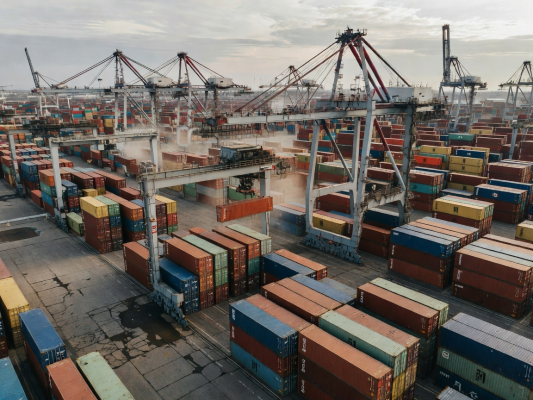
Containerized freight forms the backbone of the port’s commercial activities. The port features multiple dedicated terminals, but two stand out for their size and technological integration:
BEST (Barcelona Europe South Terminal)
Operated by Hutchison Ports, BEST is widely regarded as one of the most technologically advanced container terminals in the world. It utilizes semi-automated processes, relying on automated stacking cranes (ASCs) that maneuver containers with precise efficiency. This automation significantly reduces turnaround times for both the massive container ships at the berth and the truck fleets operating landside. Its deep-water drafts allow it to accommodate the largest container vessels currently in global operation.
APM Terminals
Another major player within the port is the APM Terminal. This facility manages a substantial portion of the port's total TEU (Twenty-foot Equivalent Unit) throughput. It boasts an extensive array of Ship-to-Shore (STS) gantry cranes and vast staging yards, providing critical links to global shipping lanes, particularly those connecting Europe with Asia and the Americas.
The ZAL (Zona de Actividades Logísticas)
A crucial component of Barcelona's logistical success is the ZAL, or Logistics Activities Zone. Rather than just moving boxes from ship to shore, the port provides a massive adjacent industrial park designed specifically for value-added logistical services. The ZAL hosts distribution centers for major multinational corporations, forwarding agents, and specialized storage facilities, including cold-chain warehouses for perishable goods.
The proximity of the ZAL to the port terminals means that goods can be unloaded, processed, packaged, and dispatched to their final European destinations with minimal delay. This integration reduces transportation costs and lowers the carbon footprint associated with hinterland transit.
Automotive and Roll-On/Roll-Off (Ro-Ro) Operations
Barcelona is a premier hub for the automotive industry. The port features dedicated terminals specifically designed for handling finished vehicles. Massive specialized parking structures hold tens of thousands of cars imported from global manufacturers or exported from regional Spanish assembly plants. The Ro-Ro terminals also support frequent ferry services connecting the Iberian Peninsula to the Balearic Islands, Italy, and North Africa, carrying both passengers and commercial freight vehicles.
Rail and Hinterland Connectivity
A port's efficiency is only as good as its landside connections. The Port of Barcelona has heavily invested in rail infrastructure. Unique to the region, the port features multi-gauge rail tracks (accommodating both standard European and wider Iberian gauges). This allows freight trains to bypass gauge-change delays at the French border, providing a direct, high-speed rail corridor into the heart of Europe. This rail integration is a key strategy in reducing the port's reliance on road trucking, aligning with broader European Union sustainability goals.