Ancient and Medieval Origins
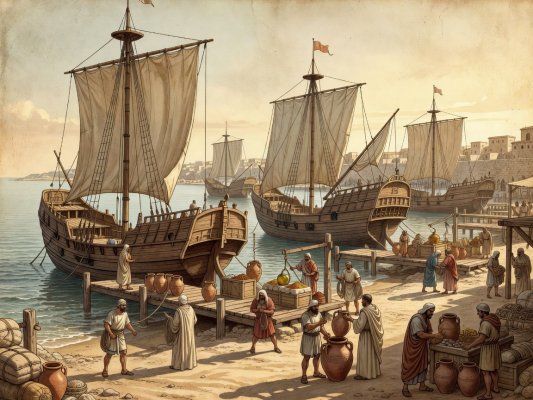
The history of the Port of Barcelona is deeply intertwined with the history of the city itself. In antiquity, the Iberian settlement of Barkeno, and later the Roman colony of Barcino, utilized the natural beaches for maritime activity. However, there was no structured port. Ships would anchor offshore, and smaller boats were used to ferry goods and passengers to the beach.
It wasn't until the Middle Ages that Barcelona began to assert itself as a naval and commercial power in the Mediterranean. Under the Crown of Aragon, trade expanded significantly. The Royal Shipyards (Drassanes Reials), constructed in the 13th century, stand today as a testament to this era. Here, war galleys and merchant vessels were constructed, fueling the expansion of a maritime empire that stretched across the Mediterranean to Southern Italy and Greece.
The First Breakwaters
Despite its commercial success, Barcelona lacked a naturally protected harbor, making ships vulnerable to Mediterranean storms. The first serious attempts to create a sheltered port began in the 15th century. In 1477, under the orders of King John II of Aragon, construction began on the first artificial breakwater. This structure, which extended from the mainland to the small island of Maians (which is now part of the Barceloneta neighborhood), formed the foundation of what would become the modern port.
The Industrial Expansion
The 19th century brought the Industrial Revolution to Catalonia, fundamentally altering the scale and scope of port operations. The advent of steamships and rail transport required a massive overhaul of the maritime infrastructure. The port was deepened, new quays were constructed, and heavy mechanical cranes were introduced.
During this period, the port expanded southward, creating dedicated zones for bulk goods, coal, and the burgeoning textile trade. The construction of the Moll de la Fusta (Wood Wharf) and various custom houses reflected the growing volume of international trade passing through the city.
The 1992 Olympic Transformation
Perhaps the most defining moment in the modern history of the port occurred in the run-up to the 1992 Summer Olympics. Prior to the games, the city's waterfront was highly industrialized, effectively cutting the city off from the sea. The urban regeneration plan involved a radical restructuring of the port area.
Industrial activities were pushed further south to the Free Trade Zone (Zona Franca), freeing up the old port (Port Vell) for public use. This era saw the creation of the Marina Port Vell, the Maremagnum leisure complex, and extensive public promenades. The port was no longer just an economic engine; it became a vital recreational space for the citizens of Barcelona.
The Modern Era
In the 21st century, the Port of Barcelona has continued its southward expansion to accommodate the massive scale of modern globalized shipping. The construction of the Logistics Activities Zone (ZAL) and deep-water terminals capable of handling mega-container ships and colossal cruise liners has solidified its position as one of the Mediterranean's premier logistical and tourism hubs.
Today, the port's history reflects a continuous cycle of adaptation—from ancient beachfront trading post to medieval shipyard, industrial powerhouse, and ultimately, a complex, modern entity balancing massive commercial throughput with urban integration and environmental sustainability.